
AI agents with high intelligence and true autonomy have long been seen as the ultimate goal of Artificial Intelligence. But every few months, a more capable model emerges, and what once felt distant suddenly looks like next quarter's roadmap.
As the tech matures, so does our willingness to hand over responsibility. The industry is moving past chatbots that surface FAQs and towards multi-agent systems that can coordinate projects, make judgment calls, and quietly run entire workflows with barely a human in the loop.
That shift raises new questions:
- Which kind of agent is right for your business?
- Do you trust a big provider, or piece something together from open source?
- And how much autonomy do you actually want to hand over?
The answers aren't obvious - partly because "AI agent" is being stretched to mean everything and nothing at once. To make sense of the noise, it helps to zoom out and look at the agency scale - a spectrum that runs from simple reflexes to full-on adaptive learning. Knowing where a given agent sits on this scale is the first step to deciding if it's the right fit for your business.
What Exactly Is An Agent?
If software is going to call itself an agent, it should be able to:
- Perceive / Observe: take in information about its environment.
- Maintain State & Goals: keep track of what it's trying to achieve.
- Decide Autonomously: act without constant human prompting.
- Orchestrate Actions: actually do something in the world.
- Use Tools: tap into external systems when needed.
But not all agents tick those boxes equally. Some are barely more than rule-based scripts. Others adapt in real time. Here's the spectrum, with examples of where they're already showing up in industry.
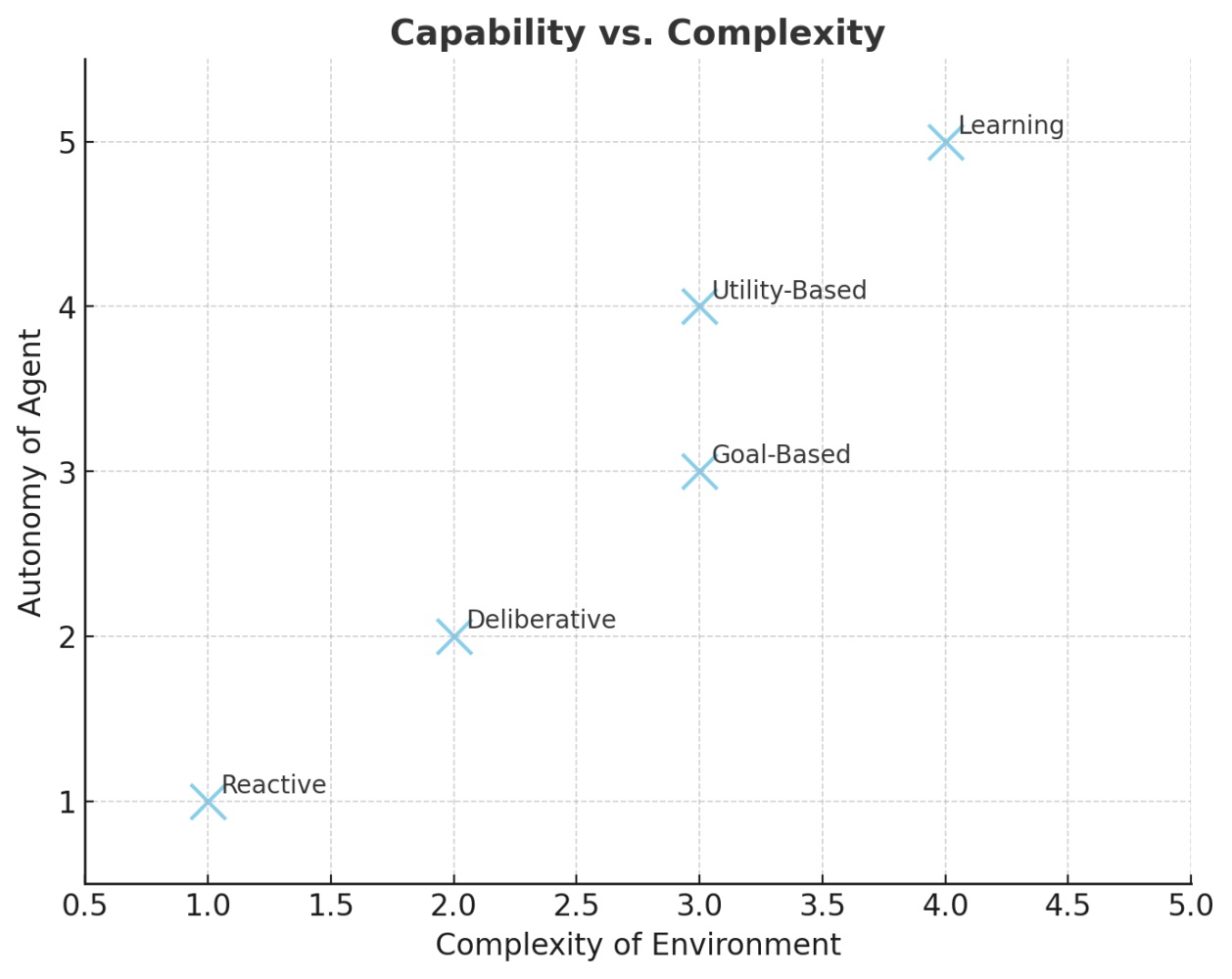
Reactive Agents
Think of a Roomba: it bumps into a wall, turns, and keeps cleaning. Reactive agents don't have memory or foresight - they just respond to stimuli with predefined rules.
- Capabilities: Fast, predictable, cheap to build.
- Limitations: No learning, no planning, fragile in messy environments.
- In the wild: Automated alerts, rule-based chatbots, "if-this-then-that" style workflows.
This is where a lot of real business automation still happens. Boring, yes. Valuable, absolutely.
Deliberative Agents
Now think of a GPS navigator: it has a model of the world (a map), considers traffic, and chooses a route. Deliberative agents plan actions before they take them.
- Capabilities: Can simulate different paths, reason about trade-offs.
- Limitations: Slower, needs accurate context models, struggles in unpredictable situations.
- In the wild: Dynamic scheduling tools, project management optimisers.
Quietly everywhere in operations. These are less hyped than "AI copilots," but they're often the backbone of complex workflows.
Goal-Based Agents
A warehouse robot told to "keep shelves stocked" is goal-based. It works toward a higher-level objective, continuously checking if its actions move it closer to success.
- Capabilities: Flexible, can adapt multiple strategies to the same goal.
- Limitations: Needs a clearly defined goal and reliable data.
- In the wild: Logistics planning, staffing schedulers, mission planning systems.
These agents introduce real adaptability without requiring bleeding-edge AI. A sweet spot for many enterprises.
Utility-Based Agents
Utility-based agents don't just aim for a goal - they aim for the best outcome, balancing trade-offs along the way. Think of a personal finance app weighing risk vs. return.
- Capabilities: Handles competing goals, optimises for maximum benefit.
- Limitations: Needs a well-defined utility function, heavy on compute.
- In the wild: Pricing engines, grid management systems, financial trading bots.
Hugely powerful, but underutilised. Few businesses bother defining their trade-offs rigorously enough to make full use of these.
Learning Agents
Here's where things get interesting. Learning agents improve over time by processing feedback - like a self-driving car refining its behavior with every mile.
- Capabilities: Improves with experience, adapts to surprises, spots patterns humans miss.
- Limitations: Data-hungry, expensive to train, sometimes unpredictable.
- In the wild: Recommendation engines, adaptive copilots, autonomous vehicles, predictive maintenance.
This is the hype zone. Everyone's talking about them. But without guardrails, they can be costly and risky. Use them when the upside justifies the complexity.
Hybrid and Multi-Agent Systems
Most real-world deployments combine types. A logistics platform might use:
- Reactive agents for basic inventory checks,
- Deliberative agents for route planning,
- Learning agents for demand forecasting.
The future is less about "one perfect agent" and more about orchestrating a team of specialised ones.
Final Thoughts
Understanding where an agent sits on the agency scale is a practical way to cut through hype and focus on what fits your business.
The temptation is always to chase more autonomy. But more AI isn't always better. The winners won't be the companies that build the smartest agent; they'll be the ones that deploy the simplest agent that gets the job done.
Start small. Match the complexity of the agent to the complexity of the problem. And remember: autonomy without direction is just noise.