
Artificial intelligence has a sustainability paradox at its core.
On one hand, AI could be one of the most powerful tools we have for tackling climate and resource challenges: optimising electricity grids, improving demand forecasting, accelerating clean energy discovery, managing supply chains, and making complex infrastructure more efficient. These types of AI use cases can be considered high value tasks, which have consequential societal benefit, and sit alongside other high value tasks such as cancer research or disaster prediction.
However, on the other edge of the double-edged-sword, the infrastructure needed to power AI is becoming a significant consumer of energy, water, land, minerals and hardware. Importantly, research has shown that the majority of energy usage doesn't occur at the one-off training stage, but rather in the inference (i.e., the day-to-day use of these AI systems). Industry reports suggest that inference accounts for more than 90% of total AI power consumption. The rest sits across the wider infrastructure lifecycle: critical minerals for chips, hardware manufacturing, steel and concrete for data centres, and eventual e-waste.
AI inference is rapidly expanding, with almost 1 billion weekly active users of ChatGPT, ~88% of organisations adopting it, and the resulting surge in demand already driving large-scale data centre growth and rising global energy consumption. To keep up with "exponential" customer growth, Anthropic has partnered with Google and Broadcom to secure multiple gigawatts of next generation compute capacity. Global electricity demand from data centres is projected to more than double by 2030, reaching around 945 TWh, which is roughly Japan's current electricity consumption.
Even when data centres are powered by renewables or renewable energy credits, the pressure does not disappear. In many cases, hyperscalers rely on renewable energy credits rather than direct clean supply, meaning overall grid demand still rises and can strain already constrained systems. As AI demand grows, it creates real resilience challenges, for example during heatwaves in hotter climates. The fact that AWS, Google and Microsoft are now investing in nuclear power highlights a shift in strategy: renewables alone are no longer seen as sufficient, so the focus is turning to always-on low-carbon energy - bringing its own environmental and societal risks (e.g., shifting impacts from carbon emissions to long-term radioactive waste, water demand, and localised community burdens.)
Crucially, this infrastructure expansion is being driven by what I will refer to as, high volume, low value demand. For example, the almost 1 billion weekly active users of ChatGPT who may be asking it to generate an image of what they would look like with a different hairstyle = LOW. VALUE.
My argument here is that focusing on individual behaviour (promoting greener AI habits) and organisational behaviour (disclosing the environmental costs of AI use) can directly reduce the high-volume, low-value demand driving today's AI infrastructure growth. Less unnecessary demand means less pressure to keep expanding AI infrastructure into new, often water-stressed and vulnerable locations, and more room for AI's genuinely high-value work to be served by the infrastructure that already exists.
Three levels of AI sustainability
Let's take a step back and consider AI sustainability from three levels: systemic, organisational and individual.
Systemic level
At the systemic level, AI sustainability is about the physical and political infrastructure of compute: where data centres are built, how they are powered, how much water they use, where chips and minerals come from, and which communities host the waste. AI expansion strains land, electricity, water, critical minerals, supply chains and e-waste systems - making it a question of national energy strategy, grid planning, industrial policy and environmental regulation.
Water is a particular pressure point because many data centres rely on large volumes of clean, treated water for cooling. In water-stressed regions, that water is not abstract: it is the same scarce resource needed by households, farms, ecosystems and local businesses. Some of it is also lost through evaporation during cooling, meaning it is not simply borrowed and returned unchanged. As AI demand grows, this can intensify competition for already limited water supplies and make local communities feel that their essential resources are being redirected to power distant digital services.
Data centres for AI are increasingly being built in locations with spare electricity (grid headroom), because access to power is now the main constraint. These locations often happen to be water-stressed not because companies are targeting dry places deliberately, but because the regions that have excess or expandable energy infrastructure - such as areas with strong solar or lower population density - tend to also be hotter and drier. MSCI reports that around one-quarter of today's data centres, and nearly one-third of those under construction, are in regions projected to face greater water scarcity by 2050.
Up until now, the most "ideal" locations for data centres were places with both strong water availability and strong power access (e.g. London, Virginia, Frankfurt). However, these areas are now saturated: there is limited land, limited grid capacity, and long delays to connect new infrastructure. As a result, AI infrastructure is flowing to where power is available, even when that means placing water-intensive data centres in water-stressed regions.
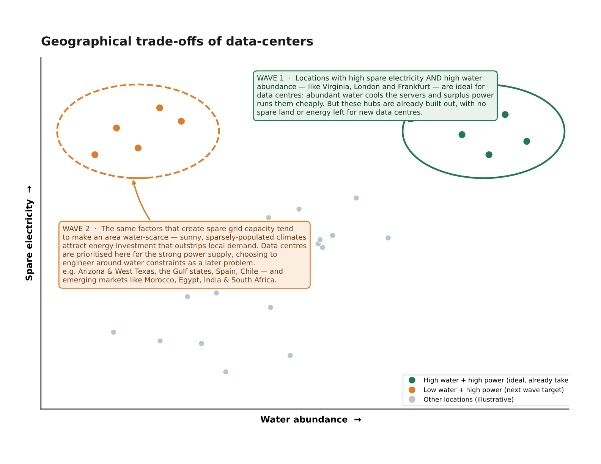
This is where environmental justice becomes central, asking who reaps the benefits from AI and who absorbs its local costs. For those who live in these areas, this can look like:
- Reduced availability of water for households and agriculture
- Potential increase in water costs or restrictions during drought periods
- Potential increase in household and local business electricity prices
However, these communities often do not receive equivalent benefits. Data centres can bring investment and some jobs, but they are typically not labour-intensive and may not offset the long-term environmental strain placed on local resources. So, while the global benefits of AI are widely distributed, the environmental costs are concentrated locally.
At the same time, AI can deliver genuinely high-value systemic benefits. Google DeepMind, for example, reported using AI to reduce data-centre cooling energy by up to 40%, while Kenya's AI strategy positions green AI as part of a wider digital transformation agenda around energy efficiency and sustainable infrastructure. Beyond climate gains, AI could also contribute to major advances in healthcare, defence, and disaster response.
The point is not that AI infrastructure is inherently bad, but that scarce compute should be directed towards uses that justify its environmental cost.
This is the crux of the systemic-level problem: data centres are not expanding only because high-value scientific, medical or climate work demands it. They are also expanding because billions of routine AI interactions create relentless demand for compute. That pace of demand is pushing new infrastructure into locations with less water resilience and more vulnerable communities.
Reducing low-value, high-volume inference will not stop AI infrastructure growth or solve the politics of data-centre siting, but it can reduce avoidable pressure on the demand curve - making more room for high-value uses and buying time for better governance, siting standards and disclosure to catch up.
I am not suggesting that this blog post will give you strategies to single handedly fight the climate crises or find a cure to cancer. I am saying that there are things that can be done at the organisational and individual levels which can reduce the pressure to expand AI infrastructure into vulnerable areas, and make more room for AI's genuinely high-value work to be served by the infrastructure we already have.
The organisational level
For organisations, the first sustainability challenge is simple: you can't manage an impact you can't see. Right now, AI use often feels environmentally weightless because the energy, water and infrastructure costs sit far away from the teams creating demand. Disclosure changes that. It turns AI sustainability from a vague aspiration into something organisations can actually govern: which tools are being used, for what tasks, at what volume, and with what value.
Once those patterns are visible, they start to influence decisions and behaviour change:
- Companies, investors and regulators can ask whether particular uses are justified.
- Teams can right-size models, redesign defaults and challenge unnecessary use.
- Leaders can connect AI deployment to both sustainability goals and avoidable licensing or compute costs.
This cannot sit with user organisations alone. Much of the environmental and efficiency data from frontier model providers is still not publicly available, which means organisations cannot always calculate the exact footprint of the models they rely on, or compare providers with complete accuracy.
But incomplete data is not a reason to do nothing. Organisations can still track useful proxy metrics, including:
- Prompt volume
- Output length
- Model choice
- Task type
- Frequency of image or video generation
- AI-related spend
Most organisations can track this using data they already have. AI platforms typically provide usage logs (e.g. prompts, tokens, model types) that can be fed into simple internal dashboards. Ownership should sit with FinOps or platform teams, working with sustainability teams to interpret impact. The goal isn't perfect measurement, but building visibility and treating AI usage as something to actively monitor and manage.
These indicators will not give a perfect footprint, but they can reveal patterns of unnecessary demand and help teams reduce waste.
Taken together, disclosure and proxy tracking make AI sustainability manageable. They help organisations move from assumption to evidence, and from broad "green AI" claims to practical choices about when AI is worth using, which model is proportionate, and where demand can be reduced.
That matters beyond the walls of any one organisation. Every unnecessary prompt, redundant model call or oversized model used for a simple task adds to the high-volume, low-value demand driving data centre expansion. When organisations can see and govern their own AI use, they can start cutting that demand at the source - reducing pressure on infrastructure and helping ensure that the compute we do build is used for work that justifies its environmental cost.
Organisational disclosure matters because it turns invisible infrastructure costs into visible choices. But those choices are ultimately made by people: product teams deciding whether to add an AI feature, managers setting defaults, and individuals choosing whether to ask for a short answer, generate ten images, or use AI at all. In that sense, the organisational level is the bridge between the systemic problem and everyday behaviour: it gives individuals the information, motivation and culture they need to use AI more proportionately.
Individual level
The individual level is where the abstract demand curve becomes everyday behaviour. A single prompt is insignificant. But billions of casual, low-value prompts are not. At scale, even lightweight queries add up quickly. Hundreds of millions per day can translate into energy use comparable to powering ~35,000 homes annually.
That shifts the sustainability question from "should we use AI or not?" to "how proportionately are we using it?" A prompt is not a fixed unit of energy. Fernandez et al. show that inference energy varies with input length, output length, task type and system configuration. This means that individual habits (or 'Greener AI behaviours') can reduce avoidable demand, without compromising quality. Such Greener AI behaviours look like asking for shorter answers, avoiding repeated generations, and not using complex models when simple ones will do – what happened to using Google for a simple question about what movie to watch? I joke, but Goldman Sachs estimated that a ChatGPT query can require nearly 10x the electricity of a Google search.
To be uber clear, this is not about guilt, and this is not asking people to stop using AI. It is about literacy. Most people would not leave the lights on in every room if they understood the cost and had easy ways to avoid it. AI needs the same kind of visible, practical sustainability culture: one where people understand that longer outputs, repeated calls and more complex media formats generally require more compute, and where "good use" means proportionate use. At scale, that shift matters. It chips away at the high-volume, low-value demand driving infrastructure expansion, and helps preserve more compute capacity for AI's genuinely high-value uses.
The governance challenge: Make the invisible visible
At all three levels, the sustainability-AI paradox is, fundamentally, a responsible AI problem. Responsible AI is usually framed around fairness, safety, transparency and accountability. In my role as a Human-Centric Responsible AI consultant at Kainos, I place sustainability firmly in that same frame, because it raises the same underlying questions. Are we using AI deliberately with visibility into its consequences, or are we using it reflexively, without understanding what it costs and who pays for it? Treating environmental cost as a governance issue - not an externality someone else will deal with - is what AI literacy and responsible AI practice actually look like in this context.
We cannot govern what we cannot see. Organisations need clearer reporting on AI resource use, better procurement questions for vendors, and practical metrics that connect AI use to sustainability goals. Individuals need simple, accessible guidance on how to use AI proportionately.
The risk is not AI itself. The risk is ungoverned demand: a culture where every product, process and person is encouraged to use more compute simply because it is available, with no visibility into what that costs, or who ultimately bears it.
The environmental justice impacts of AI infrastructure are increasingly downstream consequences of billions of ordinary inference requests, meaning AI sustainability is not just an infrastructure problem but a behavioural and governance problem. It therefore requires behavioural and governance targeted solutions:
What organisations can do today
- Start tracking AI-related energy and resource metrics, even proxy indicators (prompt volume, output length, model choice, AI-related spend)
- Ask vendors and frontier model providers direct procurement questions about energy efficiency and environmental disclosure
- Use accessible available tools, such as the AI Energy Score Project (via Hugging Face) to benchmark and evaluate many open-source models
- Set defaults that favour smaller, task-appropriate models over oversized ones used out of habit
- Build AI sustainability into existing responsible AI governance frameworks, rather than treating it as a separate initiative
- Educate teams on the real cost of AI use, so sustainable choices become a visible, normal part of how AI is deployed
What individuals can do today
- Ask for the shortest, useful answer, rather than defaulting to long-form output
- When a chat gets long, create a short "handover" summary (key context, decisions, and prompts) and start a fresh thread to avoid repeatedly reprocessing large histories
- Use bullet points or summaries instead of full prose when that's all you need
- Avoid generating multiple images or videos speculatively "just to see"
- Reuse and refine existing outputs rather than starting from scratch each time
- Pause before using AI for very small, low-stakes tasks - ask whether it's adding real value, or just convenience.