
I went to the London AI Summit braced for the usual discussion about whether AI really works. Maybe a few products with an AI badge stuck on. Throw in some cool demos of robots and the usual assortment of conference freebies. I got most of that but more interesting for me was the tension between a number of competing forces that don't yet feel resolved. It is here that I think the next 12 months of effort and conversation will focus. I'm looking forward to AI Summit 2027 to see if I'm right!

Capability is no longer the question
The demos were good. Agentic systems running in production, handling real volume, doing the unglamorous work of triage, routing and first-line response in customer service and operations. A couple of years ago these were slideware. Now they are handling millions of queries every day.
There still seemed to be a gap though, across the examples on show, the systems answer, summarise and recommend, then hand to a person. Anything that actually commits the organisation to something, typically payments or order confirmations. The capability to go further clearly exists. What is missing is the confidence to let it off the lead.
That confidence is becoming a market in its own right. Government analysis (DSIT) now puts the UK AI assurance sector at around £1bn today, with a projection to £18bn by 2035. DSIT published the Trusted Third-Party AI Assurance Roadmap in September 2025 and this month convened a stakeholder consortium to turn assurance into a recognised profession. Complete with a code of ethics, a competency framework and eventually accreditation. Standards like ISO 42001 and self-assessment tools are the early scaffolding organisations are starting to turn to.
The practical point for anyone building: the constraint on letting a system act is rarely the model. It is whether you can show, on demand, what it did, why and that it stayed inside its bounds. A governance policy sitting on SharePoint does not do that. A runtime audit trail, logging and red-teaming is more like it. Build that before you build the autonomy, because the market is about to start asking for it.
Getting it into users' hands
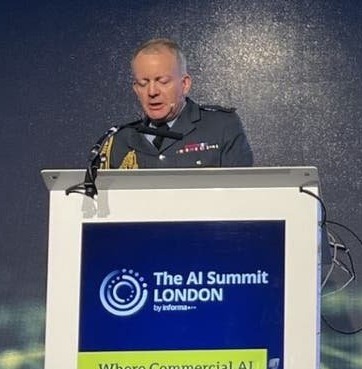
The sharper message, and it came through most clearly from Defence, was about delivery speed rather than AI capability. Their complaint was that AI is taking far too long to reach the people who need it. Rather than another strategy, they are standing up a rapid AI delivery taskforce that embeds engineers and technologists directly alongside users, picks a small number of real operational problems and builds against them at pace.
If that sounds familiar, it is the forward-deployed engineer model that many companies are starting to use to great effect and it is worth being precise about why it works. The half everyone copies is the obvious one: put the people who build the system in the room with the people who use it. The premise is sound, a lot of value leaks out in the gap between the people building the tech and the people using it. The half that gets missed is the discipline underneath. Forward-deployed engineers shouldn't be writing one-off scripts in isolation; they need build on a core foundation. This platform and the engineering rigour behind it are what makes the difference. Embed developers next to users with no rigour or assurnace, and you get bespoke tools nobody can understand, reuse or maintain.
Sovereignty means agency and control
Running underneath both of these, and pushed hard from the stage and from the minister, was sovereignty. Stripped of the politics it means practical control over your AI solution and agency to truly own it end to end. There is real and reasonable discomfort with how much currently sits with a handful of providers on closed platforms, capabilities that can be repriced or withdrawn at short notice, taking a critical workflow down with them. The cases of a capability actually being pulled are still small, famously Anthropic Fable last week, but the principle is if something you depend on is entirely outside your control, you are exposed.
Cost is what turns that risk into a top tier issue for businesses. The era of heavily subsidised AI is closing. Flat-rate access is giving way to usage-based pricing. At agentic / enterprise scale the economics get uncomfortable quickly. What was previously an easy decision to give licenses to all now requires proper scrutiny.
Sovereignty and cost are pointing at the same answer, which is why the minister leaned on it: smaller models, open weights (full open source ideally), infrastructure you control and sufficient assurance. For a good deal of public-sector work the question is quietly shifting from pure capability to a combination of cost and control.
Four forces that don't line up
So if I take a step back, the market is being pulled in four directions at once:
- AI works, and it scales. The questions of previous years have been answered.
- AI is still not reaching users fast enough or at large enough scale to be truly impactful.
- AI has to be trusted, and increasingly, independently assured.
- Organisations want control over their AI cost and capability.
The work I'm doing on AI Adoption sits in between all of these areas.
Some things worth taking away
- Evidence is the blocker for autonomy. Before you let a system take an action, make sure you can produce a record of what it did and that it stayed in bounds. Assurance is quickly becoming a procurement baseline.
- Treat deployment as a capacity problem. The defence taskforce is worth copying: embed builders with users, pick a few problems, ship something thin, iterate. The bottleneck is usually delivery, not capability.
- Assume usage-based pricing and model your ROI. While the subsidised rates are still around, work out what your AI costs per action and see if it still stacks up.
- Own what you cannot afford to lose. Where a capability is critical, weigh a open model you own yourself against a closed API you do not control.
- Assurance is a growing requirement. If you build data and AI systems, the ability to assure them is becoming part of the product.